

What do you do when you find a bug in your house?
‘We kill it,’ they answered almost unanimously. It was June at Colegio Schönthal in Buenos Aires, and I was speaking to 30 students, aged 11 and 12, in their classroom. A few days later, we would hold a workshop in our Natural Sciences laboratory. When I asked why, they gave all the reasons you could have guessed. These animals frightened them. They might bite or sting. And so on.
So I asked them a different question. Did they actually know the creatures they feared? Did they know how they lived, what they ate or whether they could really hurt them? We see these animals every day, in houses, gardens and schoolyards, where they often provoke the same reaction. A spider, an ant or anything else small enough to be unwelcome can quickly become a ‘bug’ to be killed. What if we got to know them before we acted?
Collecting with care
I proposed a challenge: over the following days, they would look for small arthropods at home, in gardens and in nearby green spaces and bring them to our workshop. I insisted that they collect them with an adult. Ants and pill bugs were easy to collect, but spiders, for example, required an adult’s help.
Before they went looking, we went through how to collect the animals without hurting them and prepare containers for the journey to school. Each container needed a little soil and leaves from the place where the animal had been found, with ventilation holes in the lid small enough to prevent an escape. They could place a sheet of paper beside the animal, wait for it to move onto the surface and then guide it gently into the container.
Some students said straight away that they were afraid to touch the animals, and that was fine. They could bring one if they felt comfortable doing so. If not, there were plenty of other ways to take part: preparing containers, bringing materials or helping their classmates, then observing and joining the discussion during the workshop.
For days, they were talking about who had found what. Then came the workshop, and the laboratory filled with excited conversation. The students arrived carefully carrying their small containers and comparing what was inside them. Between them, they had collected ants, spiders, centipedes, millipedes, pill bugs and earwigs. Now they wanted to see each other’s animals and find out what they were.
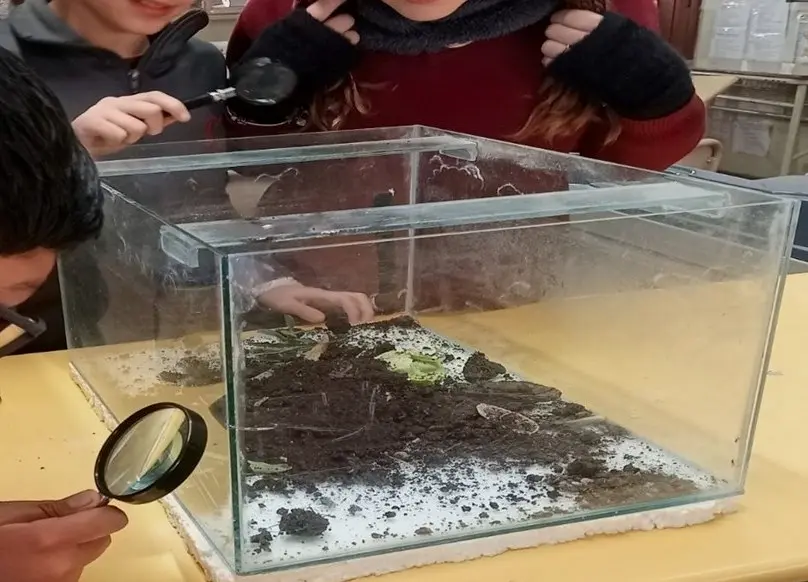
We gathered the animals in a large terrarium. With soft brushes and magnifying glasses, the students began separating the soil, taking enormous care not to harm anything hidden inside it. The questions soon followed: ‘Why does that one have eight legs? Are they all the same?’
Giving the bug a name
We continued around the laboratory’s specimen boxes, comparing their finds with preserved and identified examples. They compared a spider with a scorpion and a pill bug with other crustaceans, discovering that animals which looked similar could belong to quite different groups. Every new specimen brought more questions, and each answer sent them back to look again. The word ‘bug’ was giving way to names: spider, scorpion, crustacean.
Everyone gathered around the digital microscope, connected to the laboratory television. One by one, we placed the arthropods they had brought under the lens. Suddenly, the tiny creatures they had collected filled the screen: legs, eyes, antennae and mouthparts in detail. The students’ excitement grew, and the questions kept coming. Could this one fly? Did it have a stinger? Why did some hide from the light?
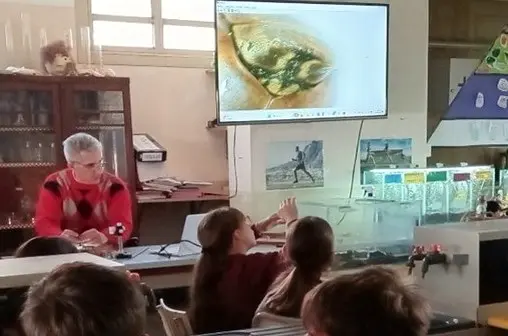
Examining the animals’ mouthparts brought us back to the students’ fear of being bitten or stung. It is true, some arthropods could hurt them and called for caution; but many were harmless.
As the discussion grew louder, I asked the students to think about where these creatures live. We often see them as intruders in our houses or gardens, although we have built on habitats that were already theirs. They are trying to adapt to an environment we have changed; we are the intruders. For some of my students, it was a eureka moment. They had never thought of it that way.
One girl had been especially uncomfortable and repulsed by the animals. When an ant tried to climb out of the main container, she reached for it and picked it up with her hand. As it walked across her skin, she watched it with surprise and said, ‘Oh, but it isn’t doing anything to me.’ She let it continue for a little while, then placed it back in the terrarium.
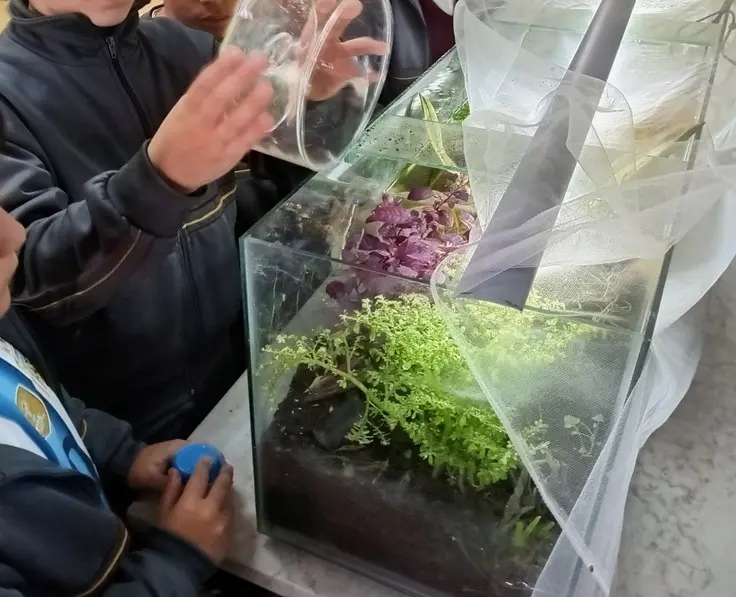
When the workshop ended, we placed the animals in one of the laboratory’s existing terrariums, with water, food and suitable conditions. The little ‘suspects’ were kept at school for ‘further investigation’. In this case, observation.
Curious minds
Some of the students who had wanted nothing to do with these animals were now peering through magnifying glasses, asking how they lived, what they ate, how they moved and how many babies they had. Before we wrapped up the lesson, I asked them whether any of it applied to human relationships too, to the way we treat one another. Do we sometimes judge someone before we know them, too?
We may see how someone behaves and decide what they are like, without knowing much about their life, what they think or why they act as they do. We can reject them without ever giving them a chance to show who they are. What might we discover if we took the time to get to know them?
About the author
Sebastián Alberto Chiapella is an Argentinian teacher of Biology, Physics and Chemistry with 27 years of experience in schools and adult education. He trained at the Instituto Superior del Profesorado Joaquín V. González in Buenos Aires. His work centres on laboratory experiences that connect scientific questions with life beyond the classroom.