
Butmir builds and leads AI software teams. He studied at Carleton University, founded and sold Applay.ai, and is now a staff product engineer at Boomband. He lives in Ottawa, Canada, with his wife, two daughters, three years old and two months, and a diabetic dog.
As his daughter starts school in a couple of years, this engineer has already begun looking for educational technology she might one day use. The only things he could find were lesson generators, digital worksheets, quiz apps and games, all of it technologically dated: slow, cumbersome and largely impractical, with AI tacked on as the one recognisably modern feature.
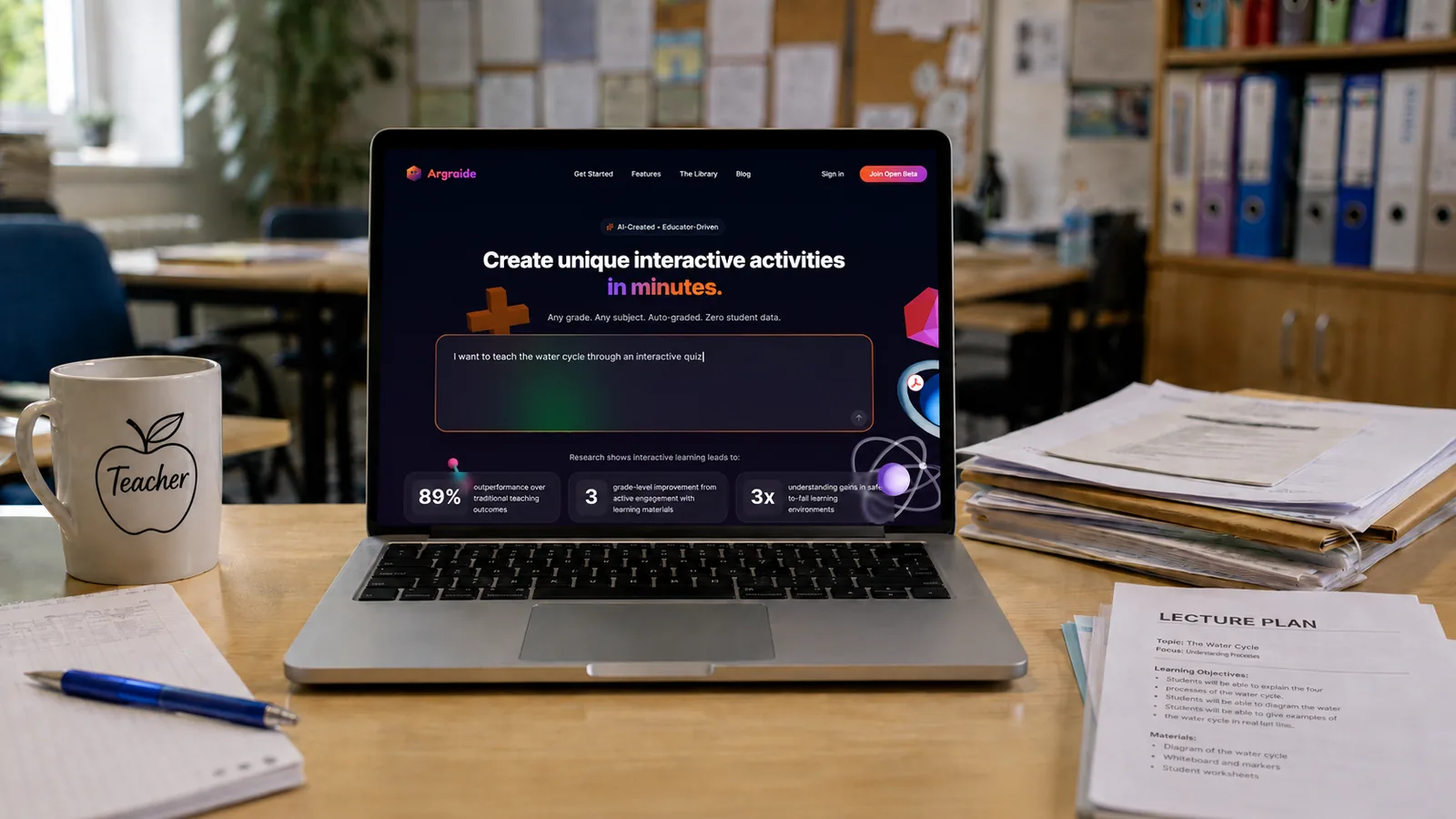
Ben decided to build the learning platform from scratch. He wanted a tool that allows a teacher to describe an activity in plain language and have a playable version ready within minutes, with content, difficulty and language easy to change, and a way of playing that suits different paces of learning. The activity can run on its own or go live, with everyone joining and interacting at once. A lesson planner and automatic marking would ease the preparation and bring the assessment around the activity itself, instead of from a separate tool.
The idea of Argraide was born, far from another quiz in a costume where the game stops, asks a question, and carries on once the answer is right. In Argraide, the subject shapes the activity itself. A lesson on ecosystems can become a simulation where every choice shifts the balance of the system. In a maths activity, each correct step opens the next. A language task can run through dialogue, where each choice leads to a different path.
Argraide is based on what developers call vibe coding. In vibe coding, a developer describes in plain words what the software should do, and AI builds it. Ben wanted the same for education: a teacher can create or change any part of a lesson just by describing it, and AI puts it together, with grading and translation built right in.
"I am very aware that I am not an educator. From the start, I did not want to build an AI content farm, churning out generic material for people to passively consume. I wanted to give teachers the tools to create activities themselves, because they are the ones best equipped to do it. That is also why I am now working directly with retired teachers and principals to make sure the platform actually lands in a real classroom. Their experience has been invaluable, but if I am honest, I need more. I need real, working teachers and their expertise to make this what it could be.
There was one more thing I felt strongly about from the start. Platforms kept collecting student data, and as someone who hates paperwork and has young kids of my own, I wanted a solution that did not require any student personally identifiable information at all. Not as a feature, but as a foundation. The challenge was still giving each student a persistent account they could carry from class to class and grade to grade. I came up with something that is elegant in its simplicity and does exactly that. It also means educators can assign these activities as homework, or a kid can do one on their phone at home, or just for fun, which quietly turns game time into more learning.
What surprised me most was how much I did not know coming into the education space.
The first surprise was technical. Building a text-prompt, vibe-coding tool meant wrestling with tokenomics and the constant balancing act of quality, speed, and cost. You can usually get two of the three easily. Getting all three, and keeping them good as new models come out every few months, took a long time and never really stops.
The second surprise changed how I think about the whole product, and it made me revisit something I felt strongly about early on. I came in believing teachers would want to build everything from scratch, and that mass-producing activities was the thing to avoid. Talking to real users taught me something different. Teachers already have so much on their plate that the last thing most of them want is to start from a blank page every time and run the full loop of ideating, generating, and testing an activity themselves. What they actually want is something good they can grab and quickly make their own. So I changed my mind about pre-built content, but not about quality. Being early, I want to give users the best possible chance of finding value, so I am releasing a pipeline that generates ready-made, curriculum-aligned activities. I do not see these as a finished product to consume. I see them as a starting point, something a teacher can pick up and edit in minutes with a simple text prompt to fit their class and their students, instead of building from nothing.
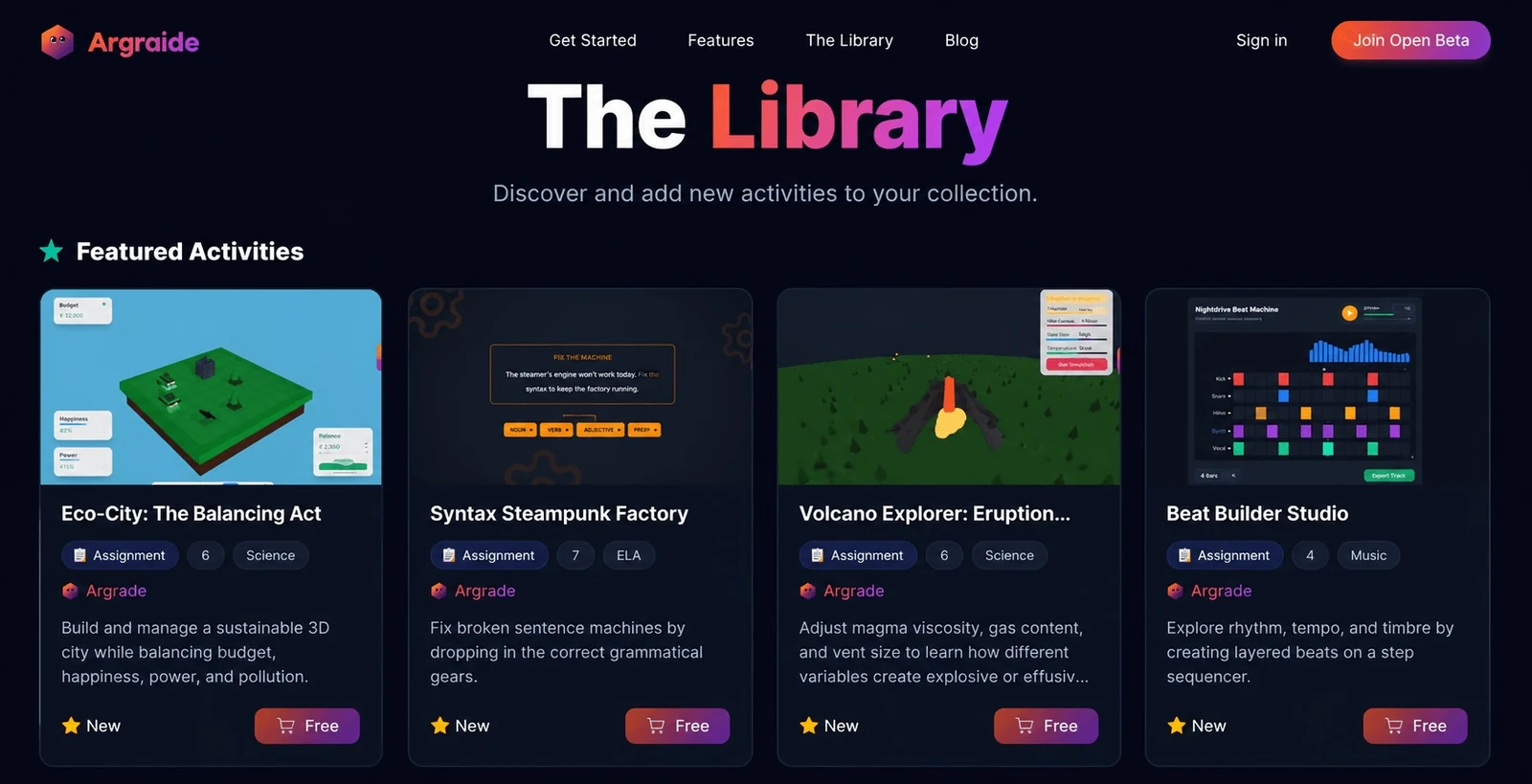
The third surprise was about money. It became clear that teachers are not just overworked, they are underpaid, and I think that is part of why something like Teachers Pay Teachers took off. But so much of what gets sold there is simple, non-curriculum-aligned AI slop. It was obvious that some teachers genuinely want to monetize their expertise, so I have been building 'The Library,' a marketplace coming soon where educators can sell their Argraide activities. Because curriculum alignment is required, buyers can trust the pedagogy behind them (a word I only recently learned to say properly). You can preview everything before you use it, and because remixing an activity is so easy, you can always tailor it to your own students.
The last surprise was the people. On teaching subreddits and other communities, educators are very divided on AI and technology in the classroom. Everyone teaches differently, and after the pandemic and a wave of AI tools all claiming the same things, I understand the skepticism. It made me more careful, not less. I would rather build something teachers want to use and find genuinely helpful than something that adds to the noise.
So let me be clear about what Argraide is not. It is not an AI tutor, and it does not replace educators in any way, shape, or form. As someone who uses AI constantly, I am convinced that trying to replace people with it is a bad idea. It should refine, not replace. All I want is to put real tools in teachers' hands, the kind that make learning more engaging, with the grading built in so they get some of their time back.
The vision I keep coming back to is simple. If you could create, edit, or find any curriculum-aligned digital learning activity you needed on Argraide, why would you use anything else? That is the thing I am chasing. And maybe, years from now, one of those teachers is standing in front of my daughter's class, running something a colleague built.
Honestly, my dream is career day. I want to walk into my daughter's class one day and tell the kids I founded the company they use every day, and make her proud. That is literally what keeps me going."
Argraide is open to try at argraide.com