
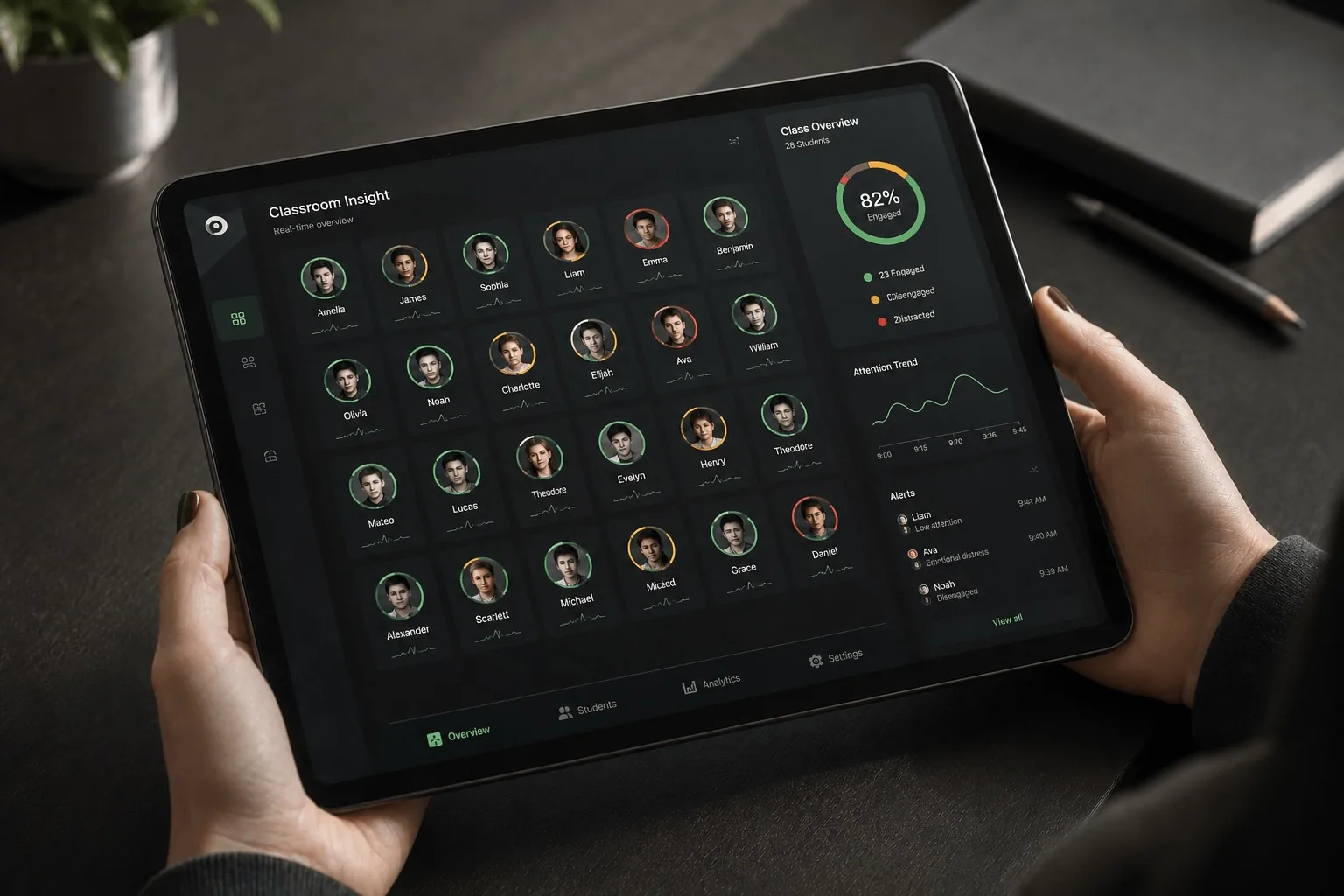
A new kind of classroom technology promises to read students before they speak. It is already in classrooms, and the first regulators have begun to ban it. The question is what is lost when learning becomes legible.
In 2018, at a high school in Hangzhou, three cameras were fixed above the blackboard and set to scan the room every thirty seconds. The software sorted each face into a set of emotions and each body into a set of actions: reading, writing, listening, raising a hand and lying on the desk. It graded attention. Students who followed the lesson were marked one way, students whose minds wandered another, and the scores were shown on a screen on the wall. One pupil said he no longer dared drift, that it felt like a pair of eyes always on him. The output is attention.

Systems of this kind belong to a field the industry calls affective computing. Versions have been built by major surveillance firms and sold into schools, most visibly in China, with interest elsewhere. The market is growing. The technology, it transpires, is easier to install than to talk about.
The pitch is familiar. Teachers cannot watch every face at once. The system can. It offers to surface what escapes the human eye: the student who tunes out at minute eleven, the cluster of confusion when fractions are introduced, the early flicker of distress before a test. Vendors describe it as an extra pair of eyes, calibrated for the welfare of the child. For a certain kind of school the appeal is intuitive. Class sizes have grown. Teacher attrition keeps climbing. Mental health referrals among adolescents have risen above the capacity of most systems to respond. Anything that promises to find the quiet child before the quiet becomes a crisis carries weight.
The difficulty begins with what the camera actually reads. It reads movement. The eye, the muscle, the tilt of the head. A child who looks at the floor while thinking is scored as disengaged. A child whose eye contact follows its own logic is flagged again and again. The richness of why a child looks the way she does, which is what teaching rests on, is invisible to the lens.
Underneath the product sits a scientific claim that much of the research does not support. In 2019 a group of five scientists led by the psychologist Lisa Feldman Barrett reviewed more than a thousand studies on whether emotion can be read from facial movement. Their finding was that it cannot, at least not reliably. A scowl is not a settled sign of anger, a smile not a settled sign of happiness. The same feeling shows itself in many ways, and the same expression carries different meanings across people, situations and cultures. What these systems sell as reading emotion is inference built on disputed ground, delivered into rooms full of developing humans and presented as data.
In Europe, regulators have started to say so. Since February 2025 the European Union has prohibited the use of AI to infer emotions in schools and workplaces, with narrow exceptions for medical and safety use. The reasoning is plain: the systems are unreliable, they intrude, and the gap in power between a teacher and a student, or an employer and a worker, makes the watching hard to refuse. A school in the Union that scans faces to grade attention is now on the wrong side of the line.
Schools rarely encounter that argument. They encounter the dashboard, which is designed to be legible. The numbers feel solid. They feel like progress, which in education has long been measured by what can be counted.
Students work it out quickly, and what they describe is unsettling. You begin to distrust your own face. You sit in class and wonder whether the way you are looking is being read as bored. You start to perform attention, and after a while you cannot tell whether you are paying attention or only appearing to.
This is where the concern deepens, and it sits some distance from the technology itself. Schools have always observed children. Teachers read faces. Houseparents notice when a student stops eating, when the dorm has gone quiet by ten. The watching, when it works, is the foundation of pastoral care. What shifts, when the watching is automated, is what the seeing produces. A teacher who notices a quiet child carries that observation in the texture of a relationship. A camera that flags a quiet child produces a record. The record can be queried, exported, shared and retained. It enters the institutional memory of a school in a way a teacher's quiet concern never has. The task a school sets itself is to know its students, and knowledge handed to software is a different kind of knowing. Some heads have refused the systems for that reason alone.
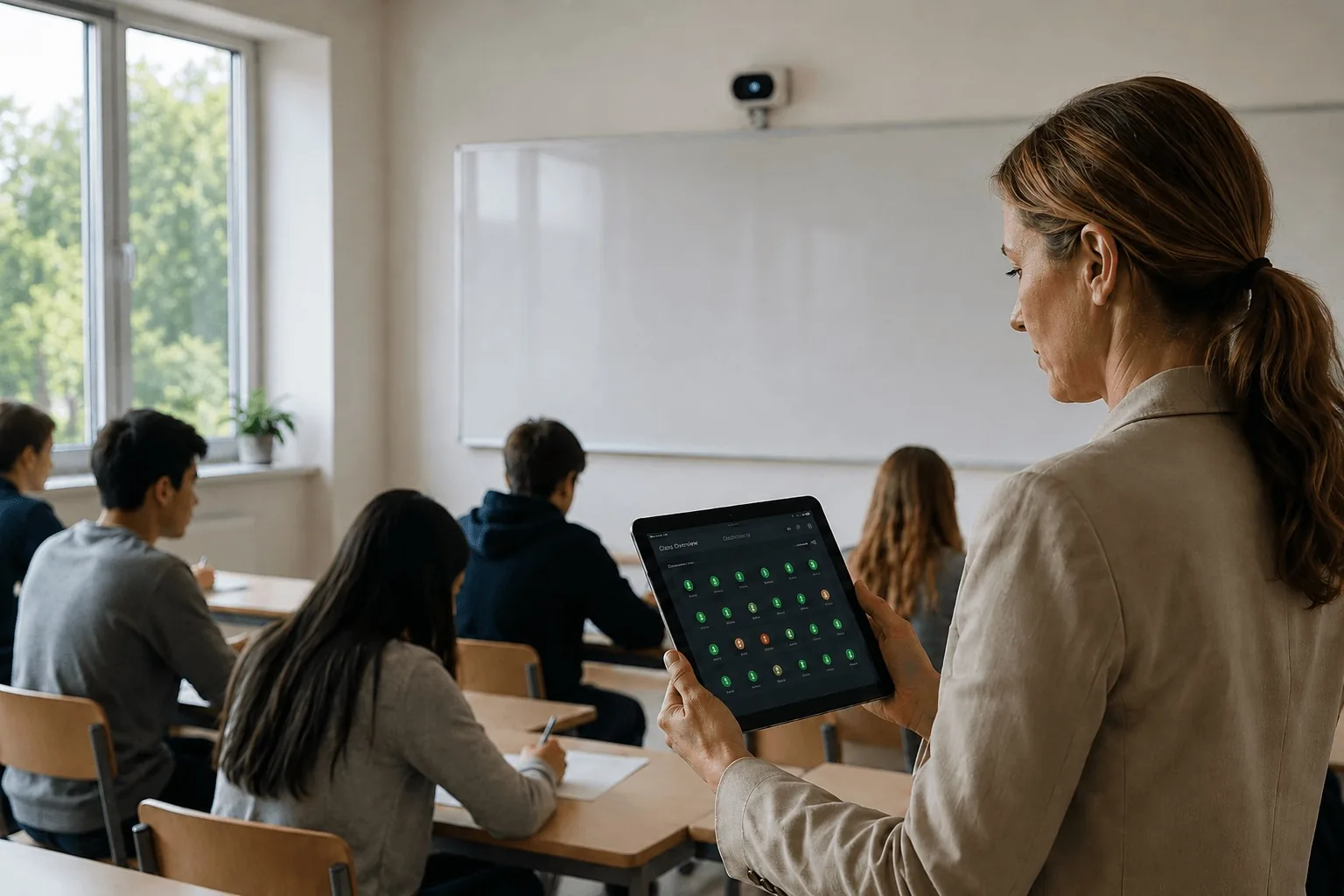
There is a case on the other side, and it deserves to be heard. Some in education argue that the technology is here, that it is improving, and that the work now is to shape how it is used. They point to early signals in children whose mental health is deteriorating, where an alert has let a school step in sooner. They point to neurodiverse students whose needs a dashboard picked up when adults had missed them. The real questions, they argue, are governance, training, consent and proportionality.
The argument has merit. It is also the argument that has accompanied every classroom technology presented as inevitable. The interactive whiteboard, the one-to-one device programme, the learning analytics platform: each arrived with similar logic, and each has reshaped, in ways large and small, what it means to be a teacher and a student. Some of those changes have been useful. Others have quietly subtracted something from the room.
What is being subtracted now is the hardest thing to see. Teachers know their students better than any camera. The quieter cost may be the slow normalising, in young people, of the assumption that their interior life is legible to a system, and that legibility is a condition of belonging in a room.
Schools have spent decades trying to teach children that they are seen. The phrase appears in safeguarding policies, mission statements and induction packs. To be seen, in school language, has come to mean being known, valued and attended to. The new technology offers a parallel meaning, more literal and considerably colder. To be seen, now, can also mean being recorded, scored, sorted into amber and red on a teacher's tablet.
The two meanings stand apart. A school that loses sight of the difference, that begins to treat the second as a sufficient version of the first, will have changed something fundamental about what it offers, even if the timetable, the uniform and the buildings remain the same.
Even where a school proceeds carefully, informing parents, appointing someone to hold the data, reviewing the readings and overriding them often, the unease does not lift. The honest position, once the marketing is set aside, is that no one is yet sure whether the school is using the system or being used by it.
That uncertainty is the true condition of education at this moment. The technology is moving faster than the conversation around it. Where the conversation exists, it has tended to happen between vendors and procurement officers, with students, teachers and parents arriving late.
The classrooms of the next decade will watch their students. The question that remains is whether they will also, still, be paying attention.






.avif)


